Why Reactive-Only Service Costs More Than You Think
Each unplanned HVAC callback in a Toronto condo building costs 2 to 4 times what the same scope would cost under a planned maintenance program. The multiplier comes from three sources. First, after-hours and emergency premiums (24/7 dispatch costs 50 to 100 percent more than scheduled service). Second, emergency parts markup (specialty actuators and motors sourced on same-day delivery carry 30 to 60 percent premium over scheduled procurement). Third, the cost of water damage events the preventive program would have caught (an average Toronto condo pan leak costs $8,000 to $25,000 in remediation across the originating suite and the suite below).
A 200-unit building running reactive-only typically spends $85,000 to $140,000 per year on combined HVAC callbacks, water damage remediation, and property management coordination time. The same building running semi-annual preventive typically spends $45,000 to $70,000 total, 40 to 50 percent savings on the annual HVAC line item.
Property manager coordination time is often the hidden cost. Reactive-only service requires property management to field resident complaints, schedule emergency dispatches, approve emergency scope, invoice tracking, and insurance file coordination for water damage events. For a 200-unit building this averages 8 to 15 hours per week of property manager time. Preventive programs reduce that coordination load to 1 to 2 hours per week, property management reviews the per-suite reports and signs off on next-year scope rather than firefighting daily.
Reserve Fund Study Integration
Reserve fund studies commissioned under Ontario Condominium Act regulations project capital expenses based on equipment age, service life, and condition. Without site-specific data, the projections run on industry-average lifespan assumptions that carry 20 to 40 percent uncertainty.
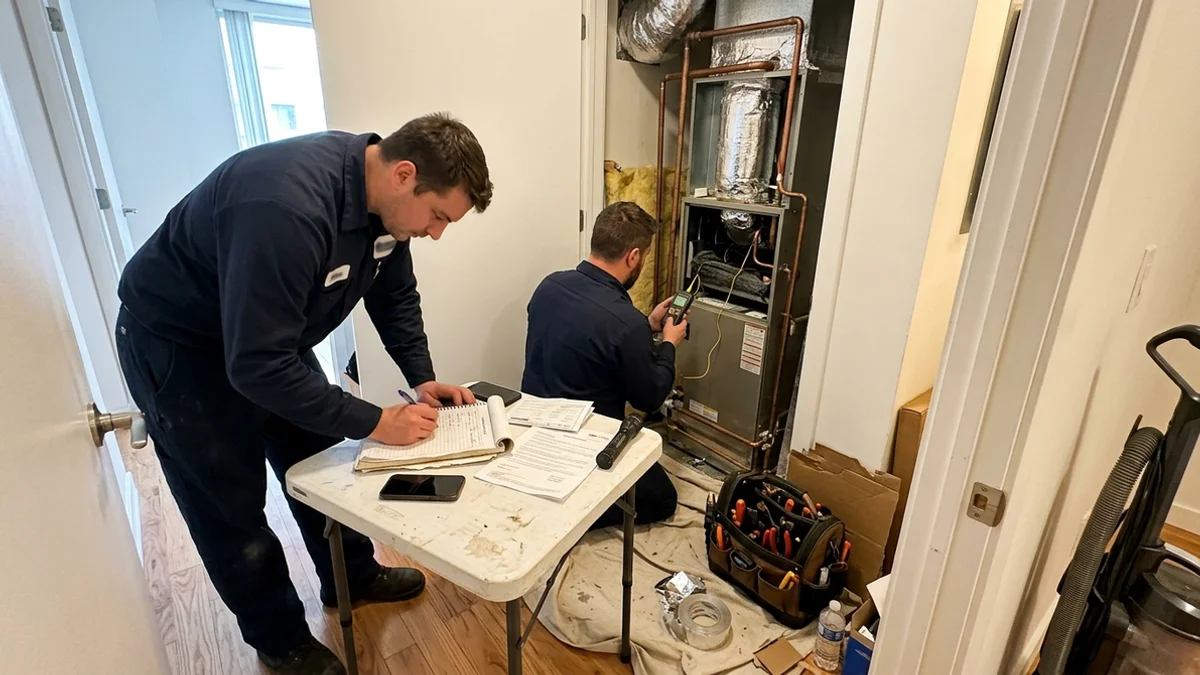
Our maintenance contract output solves this. Per-suite written reports include equipment-level data that your reserve fund consultant can plug directly into the study: age, model, condition rating, moisture reading, blower amp draw, pan integrity, zone valve stroke, filter condition. After 2 years of baseline data collection, projection uncertainty typically drops from 20-40 percent to 5-10 percent.
For a 200-unit building, that uncertainty reduction translates to roughly $150,000 to $400,000 in avoided over-collection or under-collection on the capital reserve across a 25-year study horizon. For 400-unit buildings the number scales proportionally.
The Semi-Annual Advantage
Annual single-visit programs are the baseline. Semi-annual programs (spring plus fall) typically reduce reactive callback rate by 60 to 80 percent compared to annual-only baselines. The compounding effect:
Spring visit (cooling-season commissioning):
- Filter replacement before high-load cooling demand
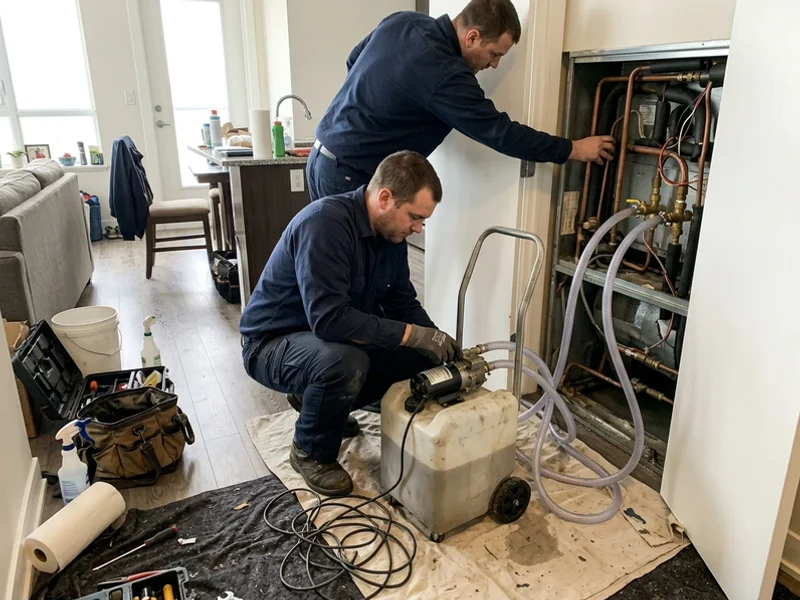
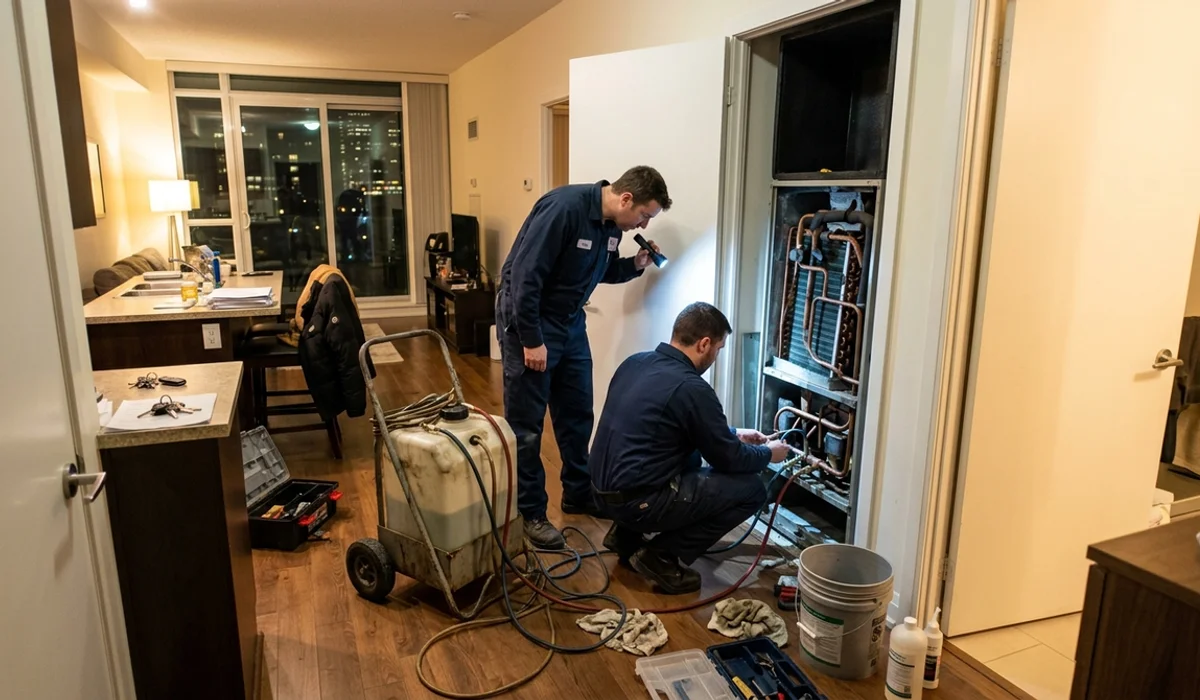
- Condensate pan vacuum and flush before peak humidity season
- Coil descaling where TDS exceeds 400 ppm
- Condensate pump test with intentional float switch flood
- Refrigerant charge verification on heat pumps
Fall visit (heating-season commissioning):
- Zone valve actuator stroke verification before heating demand
- Thermostat calibration against reference instrument
- Blower motor service and amp draw check
- Filter replacement before indoor-air-quality season
The predictable rhythm catches pre-failure indicators 6 to 18 months before unit failure, which allows scheduled replacement rather than emergency replacement. Scheduled replacement costs 50 to 70 percent less than emergency replacement across the same scope.
New-Build Commissioning Contract Window
Condo buildings in the 1 to 5 year post-handover window are a specific case. Equipment is still under original contractor warranty. Deficiencies from install errors are still surfacing. The warranty expiry clock is running.
Our new-build commissioning contract establishes a baseline documentation of all equipment as-installed, which gives the condo board a reference point for warranty claims against the original installing contractor. Quarterly condition reports flag deficiencies as they appear. Warranty claim coordination handles the paperwork with the original contractor on the board’s behalf.
Typical outcomes on new-build contracts:
- 15 to 40 equipment deficiencies identified and claimed under contractor warranty in year 1
- Warranty-covered replacement value: $25,000 to $120,000 per 100-unit building
- Clean operating baseline established for the subsequent long-term maintenance program
- Reserve fund study starts with site-specific equipment data from day 1 of post-warranty operations
New-build contracts typically run $280 to $380 per unit per year, which is the lowest per-unit pricing in our maintenance program family because the equipment is new and most scope is baseline documentation rather than active service.
Multi-Year Contracts and Price Locks
Standard contract options:
- 1-year contract: Annual pricing, no commitment beyond the term
- 3-year contract: Year 1 price locked, Year 2 and Year 3 escalation capped at CPI
- 5-year contract: Year 1 price locked, Year 2-5 escalation capped at CPI, with option for mid-term renegotiation if equipment stock changes significantly
Multi-year contracts give the condo board a predictable budget line item for the full contract term. For boards managing capital planning across multiple fiscal years, the price certainty is often the primary value, not the price itself. Early termination clauses allow the board to exit with 60 days notice if contract performance underdelivers.
Portfolio Contracts for Property Management Companies
Property management companies managing multiple condo buildings qualify for portfolio contract pricing. One contract covers HVAC maintenance across the full portfolio with:
- Consolidated billing across all buildings
- Standardized reporting format across buildings
- Portfolio-level analytics (failure rate benchmarking, equipment vintage planning, cross-building capital planning)
- Single point of contact at our end for all buildings in the portfolio
- 15 to 25 percent discount against single-building program totals
Portfolio contracts work best for property management companies with 500 to 5,000 units under management across 3 to 15 buildings. Reach out with your portfolio size and equipment mix for custom pricing.