When Repair Stops Making Sense
Reactive fan coil repair has a crossover point. For most 1980s-2000s McQuay, First Co and Unilux stock in Toronto condo buildings, that crossover arrives around year 25 of service life. Pan corrosion begins to appear on multiple units in the same vintage stack. Blower motors fail at 2 to 4 units per cooling season instead of the historical 0 to 1. Zone valve actuators seize at unpredictable intervals. The service bill per suite is climbing above 30 percent of replacement cost per year.
At that point a planned replacement program delivers a lower total cost of ownership than another five years of reactive callbacks. The savings compound: you stop paying for repeated service visits that only buy a few more months, you eliminate the water damage risk from pan failures, you reset the equipment warranty clock, and you give the reserve fund study a clean 25-year replacement baseline to plan against.
What a Building-Wide Program Actually Looks Like
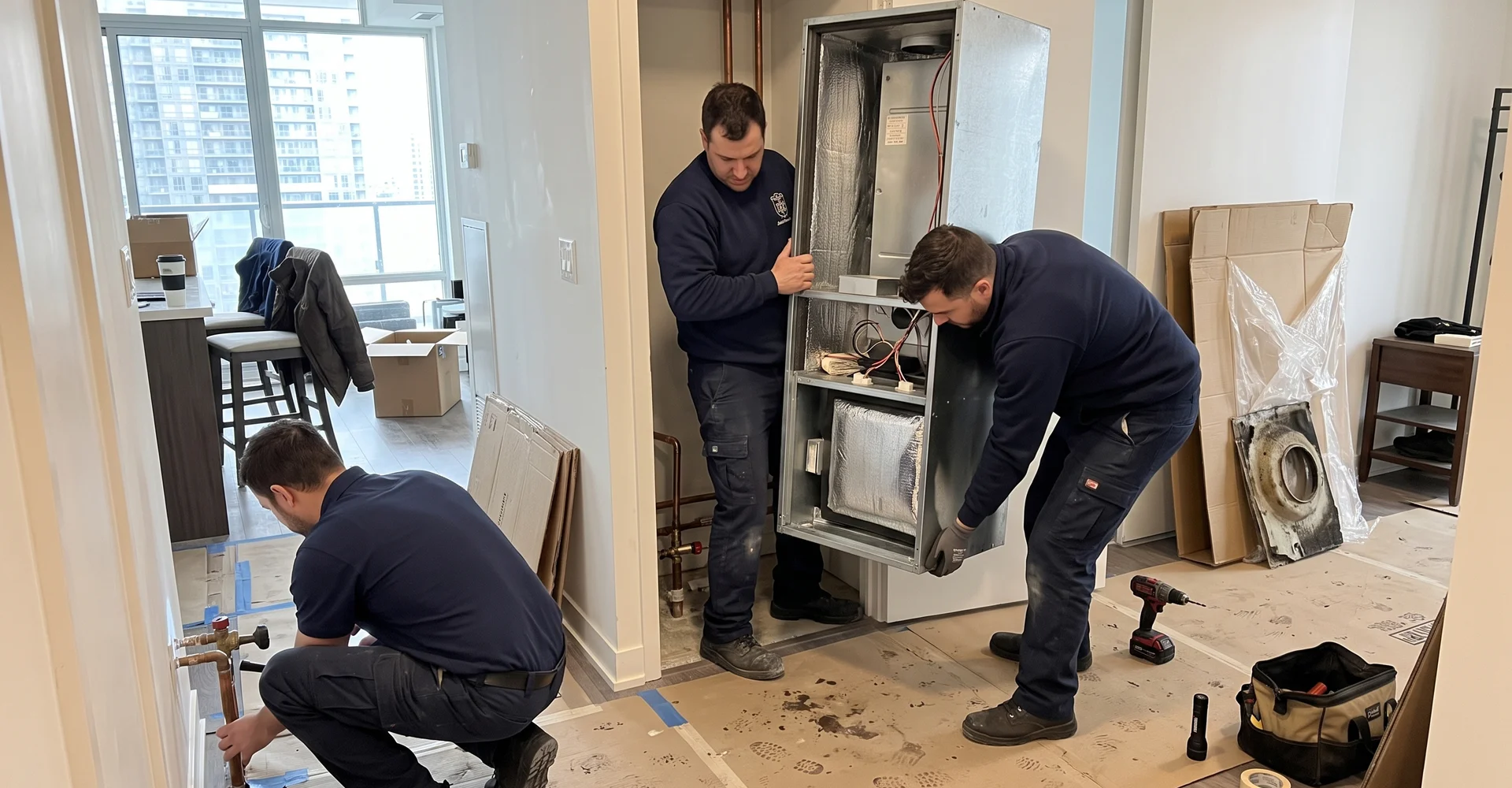
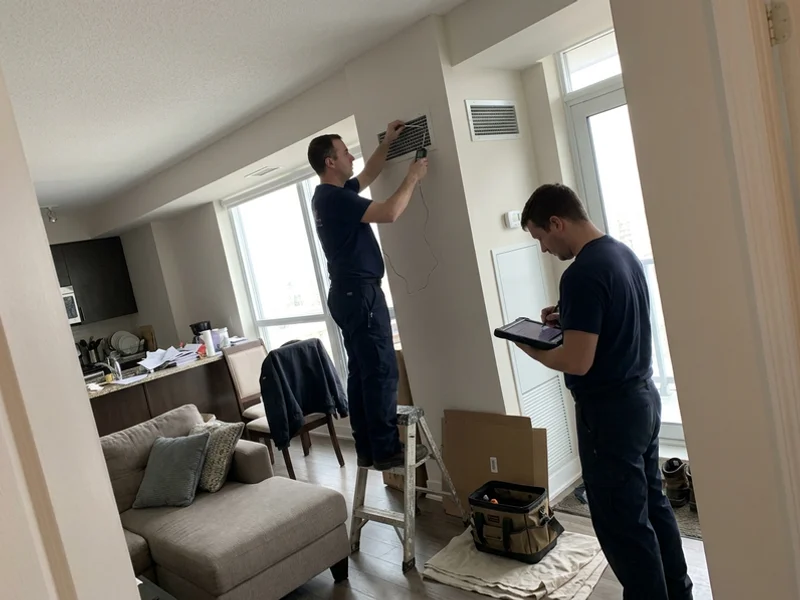
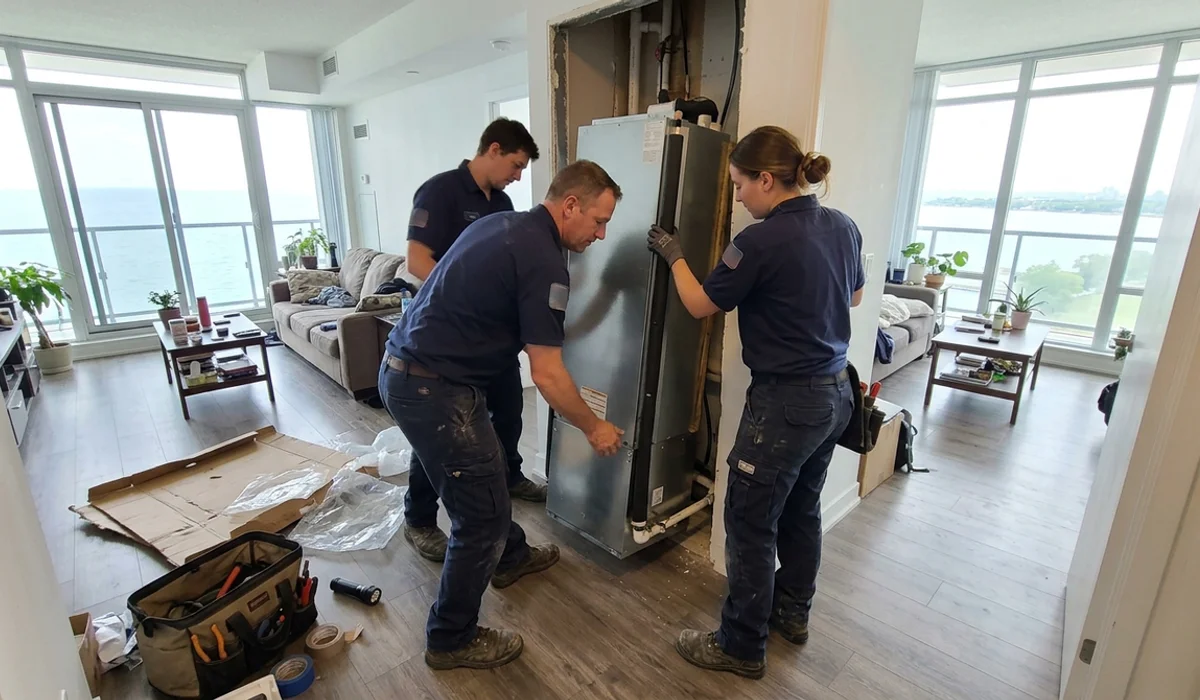
A typical 180-unit building-wide program runs 14 consecutive weeks of on-site work. The Mimico 180-unit lakefront program we completed earlier this year ran exactly that cadence: 13 units per week over 14 consecutive weeks with a 15th week reserved for punch list. Water-off window per suite averaged 3 hours 20 minutes against a 4-hour commitment. Zero residents displaced. Zero commissioning failures.
The install sequence per suite:
- Pre-install: 72-hour advance written notice (door-slip plus email plus resident portal)
- Morning-of: knock reminder from on-site resident coordinator
- Install: 4-technician crew, 90-minute nominal window
- Commissioning: 15-minute heat and cool verification before sign-off
- Documentation: per-unit commissioning report delivered to property management next morning
Corridor floor protection stays in place for the full 14 weeks. A dedicated phone line is staffed Monday through Friday 8 AM to 6 PM for resident questions. The resident coordinator shadows the schedule throughout.
Reserve Fund Study Integration
Reserve fund studies commissioned under the Ontario Condominium Act regulations flag fan coils as a capital expense when equipment reaches 70 to 80 percent of its design service life. The study assigns a remaining service life estimate and a projected replacement cost. For most Toronto condo boards, these projections are built on industry averages rather than site-specific equipment data.
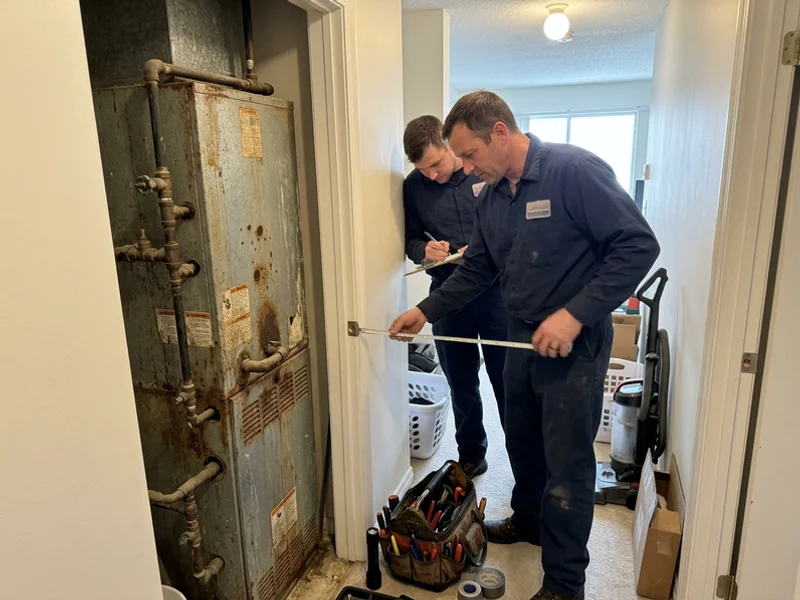
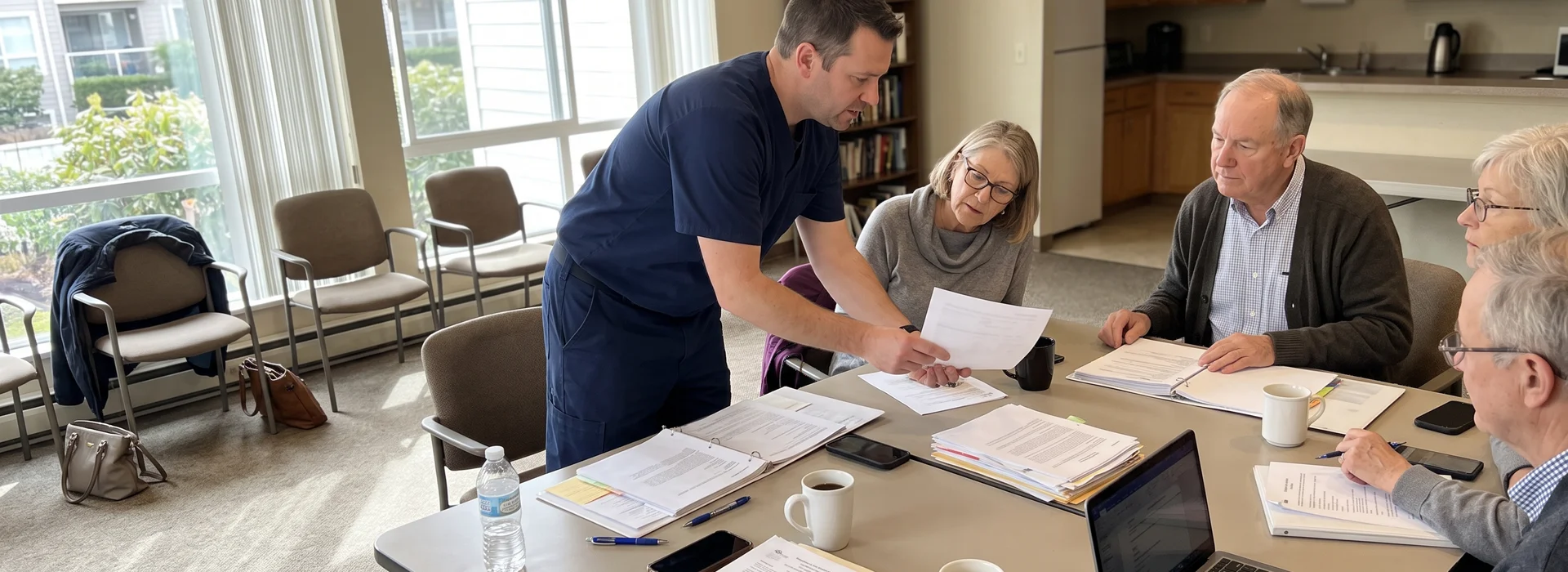
Our walk-through assessment gives your consultant the site-specific data: age, model, condition rating, moisture reading, blower amp draw, pan integrity status, zone valve condition. The consultant can then build a reserve fund projection with 10 to 20 percent lower uncertainty than the industry-average baseline. For a 400-unit building, that uncertainty reduction is often worth $150,000 to $400,000 in avoided over-collection or under-collection on the capital reserve.
For phased programs we deliver the install sequence in a format that maps directly to the reserve fund study’s year-by-year capital schedule. A 30-40-30 split across 3 years, for example, matches the collection schedule your residents are already paying into. No surprise special assessments. No capital shortfall at commissioning time.
Equipment Specification: Why Enviro-Tec HVL for McQuay Replacement
McQuay vertical fan coils dominated the Toronto condo market from the late 1970s through the mid-2000s. Original cabinet footprints across that era standardized around a few consistent dimensions, which means modern replacement units can be matched for drop-in installation without closet modifications on most buildings.
Enviro-Tec HVL hydronic fan coils are our standard replacement spec for McQuay stock because the HVL cabinet footprint matches the McQuay standard dimensions within a quarter-inch tolerance. That means no slide-out rail modifications, no closet reframing, no drywall patching. The install sequence stays simple: remove old chassis, slide new chassis into existing rails, connect water supply and return, connect condensate line, connect 24V thermostat wiring, connect filter housing, commission.
For buildings where the engineer or architect calls for a specific alternate brand (Trane or First Co), we handle those specifications too. Trane fan coils match Unilux original stock cleanly. First Co handles its own replacement path with minimal modifications. All equipment carries 5-year manufacturer warranty on parts, extendable to 10 years with an annual service contract.
Phased Payment Terms
Standard payment structure for building-wide programs:
- 15-25 percent deposit at signed contract
- Progress billing per completed phase (weekly for programs under 20 weeks, monthly for programs over 20 weeks)
- 10 percent retention held until final commissioning sign-off at end of program
For multi-year phased programs, each phase gets its own full payment structure. A 3-year 30-40-30 phased program has 3 separate deposits, 3 separate progress billing cycles, and 3 separate retention releases. This payment structure matches the way your condo corporation collects capital reserve from residents, avoiding the cash flow stress of a single large payment at completion.
Why the Written Commissioning Report Matters
Beyond the equipment itself, the written commissioning report is the real deliverable from a replacement program. The report establishes the baseline date for the next reserve fund study cycle, which means your 2051 forward-planning horizon starts the day the final unit is commissioned.
The per-unit report includes:
- Chassis model and serial number
- Install date and crew lead
- Baseline supply and return water temperature
- Baseline blower motor amp draw against nameplate
- Baseline air temperature differential (supply vs return)
- Filter model and installed date
- Zone valve actuator model and 24V test result
- Condensate pump model and float switch flood-test result
These data points become the “year zero” baseline for the reserve fund study. In year 5, year 10, year 15 of service, your consultant has clean baseline data to compare against for predictive capital planning. No more industry-average guesswork.